Twisted Mountain Climber
Demonstration video

Recommended by our experts
Receive your personalized program
Stop training at random.
Get my program- Program tailored to your profile
- Guided progression
- Compatible with your equipment
- Structured plan
Our coach prepares your program
Get my programHow to do Twisted Mountain Climber
Instructions
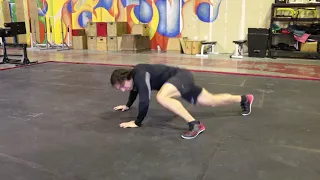
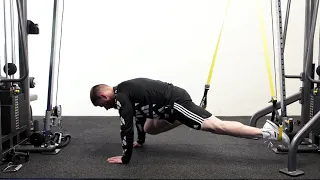
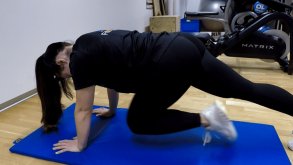
- Start in a high plank position with hands aligned under shoulders and body in a straight line.
- Engage your core and draw your right knee toward your left elbow.
- Return your right foot to the starting position.
- Immediately drive your left knee toward your right elbow.
- Continue alternating legs in a controlled, rhythmic motion.
Technical Tips
- Keep your hips level to avoid excessive rotation.
- Engage your core to stabilize your torso.
- Maintain consistent breathing and tempo throughout the set.
Breathing Tips
- Exhale as you drive your knee toward the opposite elbow.
- Inhale as you return the leg to the starting position.
- Maintain steady breathing to support endurance.
Medical restrictions
- Lower back injuries
- Wrist pain or carpal tunnel syndrome
- Shoulder instability
- Recent abdominal surgery
Description
The Twisted Mountain Climber is a dynamic bodyweight exercise designed to improve core strength, stability, and cardiovascular endurance. Unlike the traditional mountain climber, this variation introduces a cross-body motion that specifically targets the obliques and engages additional stabilizing muscles throughout the lower body and trunk. The twisting action helps activate the internal and external obliques more intensely, making it an excellent choice for sculpting the waistline and improving functional rotational strength.
This exercise is highly effective for fat burning and improving agility due to its fast-paced, alternating leg motion. It's particularly popular in HIIT routines, functional training, and core-focused workouts. The Twisted Mountain Climber also enhances coordination and balance, as it requires the body to stabilize while performing a controlled cross-limb movement.
Ideal for home or gym use, the Twisted Mountain Climber requires no equipment and can be easily adapted to suit different fitness levels. Whether you're working toward a stronger core, better athletic performance, or general conditioning, incorporating this movement can contribute significantly to your fitness goals.
Frequently asked questions
-
What muscles do twisted mountain climbers target the most?
Twisted mountain climbers primarily target the abdominal muscles, especially the obliques, while also engaging the adductors, quadriceps, glutes, and stabilizing muscles of the back. -
Is the twisted mountain climber good for burning belly fat?
Yes, the twisted mountain climber is an effective high-intensity exercise that helps burn calories and promote fat loss, particularly around the core and waist when combined with a proper diet. -
Can I do twisted mountain climbers every day?
Twisted mountain climbers can be performed daily if volume and intensity are managed properly, but it's recommended to include rest or variation to avoid overuse injuries and support recovery. -
Do I need equipment for twisted mountain climbers?
No, twisted mountain climbers are a bodyweight-only exercise that can be performed on any flat surface, ideally with a yoga mat for comfort and grip. -
How can I make twisted mountain climbers more challenging?
You can increase the speed, extend the duration, or combine them with other movements like push-ups or plank holds to intensify the workout and boost muscular endurance.

Related fitness articles
See all
Body recomposition: lose fat while building muscle
Muscle gain

Fitness formulas: protein, water, creatine and caffeine
Muscle gain

Carb cycling: useful for losing weight and performing better?
Nutrition

Muscle failure in strength training: what the science says
Muscle gain

Peptides in bodybuilding: effectiveness and risks
Nutrition
Chest pump push-up workout
Muscle gain
Succeeding at your first pull-up
At the gym

Shoulder pain in weight training: prevention and solutions
Risk of injuries
Recommended by our experts
Receive your personalized program
Stop training at random.
Get my program- Program tailored to your profile
- Guided progression
- Compatible with your equipment
- Structured plan
Our coach prepares your program
Get my program